
Case Study: LTC vs IUL vs Whole Life for Care Planning at $300-$500/mo
Bottom Line
Here, long-term care insurance provides dedicated care benefits; whole life adds a death benefit subject to required premiums. Indexed universal life growth is not guaranteed, and the illustrated accelerated benefits reduce the death benefit.
Request life insurance comparison helpFour ways to set this up: long-term care on its own, a single F&G policy that does a bit of everything, or long-term care paired with either a guaranteed whole life or a growth-focused IUL.
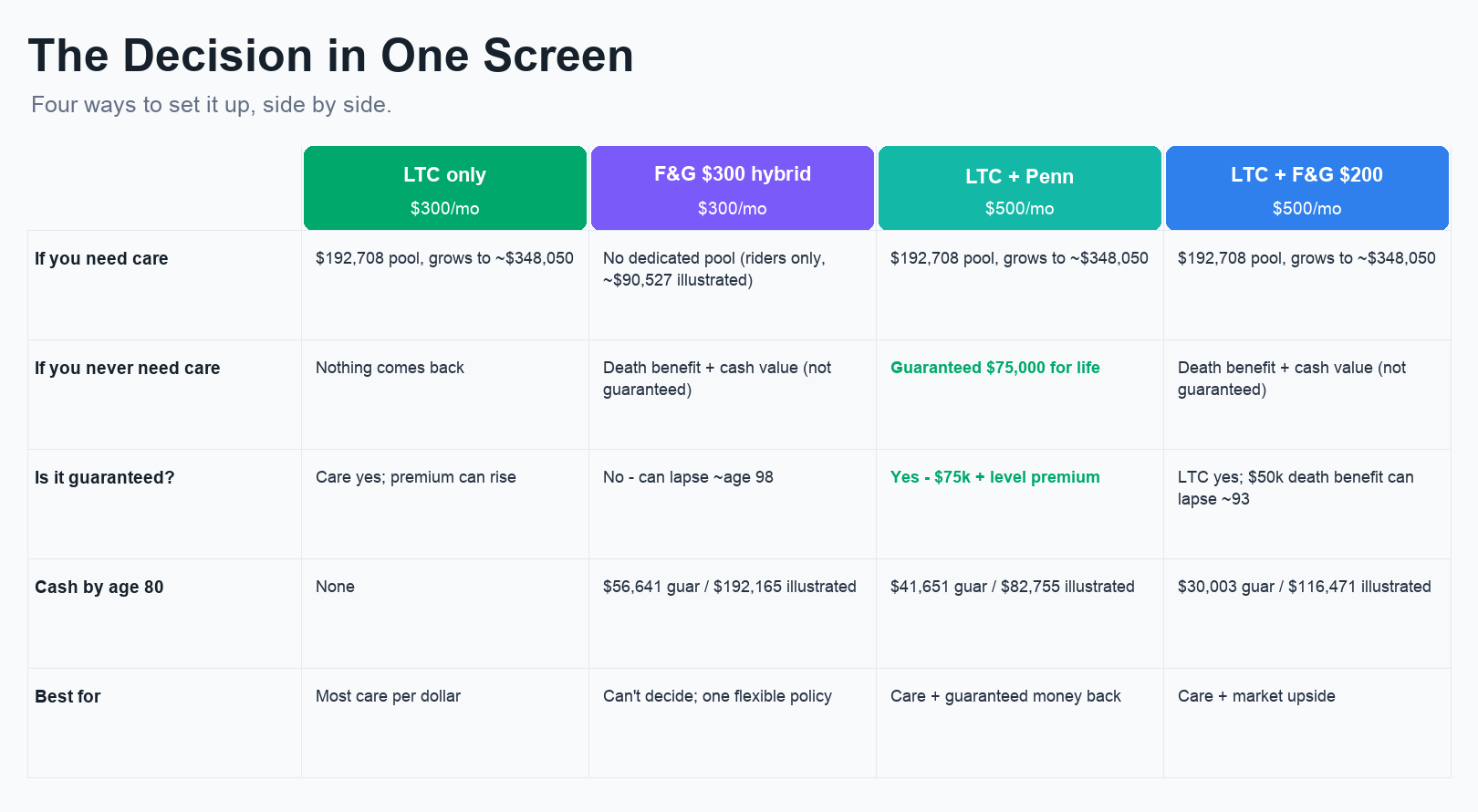
You’re in your mid-50s and in good health. Two of these plans run about $300/month and two run about $500. They differ on two things — how much money is dedicated to care if you need it, and how much comes back if you never do. Everything here uses the actual illustrations prepared for you.
The decision in one screen

View full-size chart
Scroll across and down to read the chart. Close this view when you finish.

View full-size chart
Scroll across and down to read the chart. Close this view when you finish.
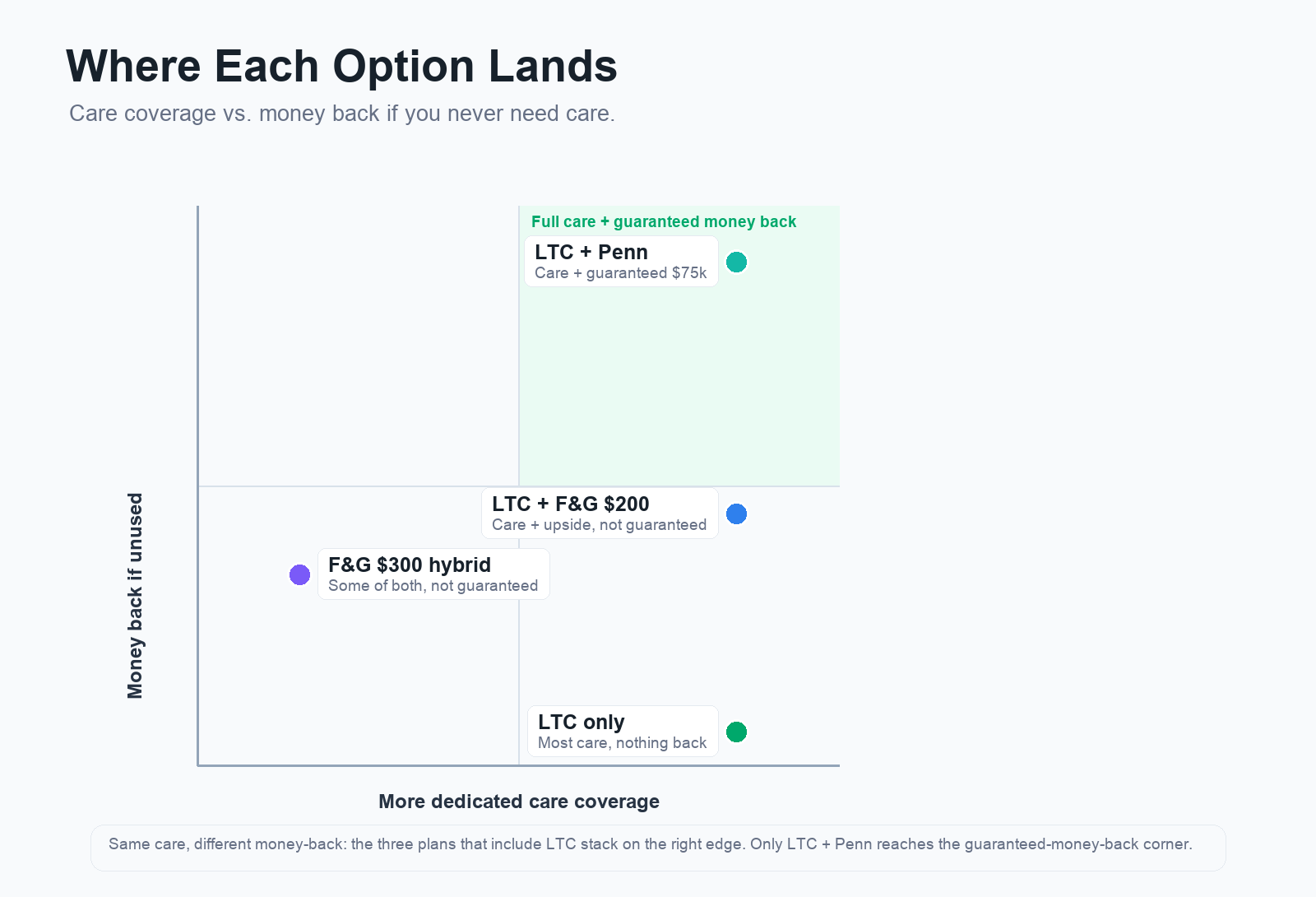
Three of the four give you the same dedicated care pool; they differ in what comes back if you never need care. Only LTC + Penn lands in the “full care + guaranteed money back” corner.
Pros and cons of each option

View full-size chart
Scroll across and down to read the chart. Close this view when you finish.
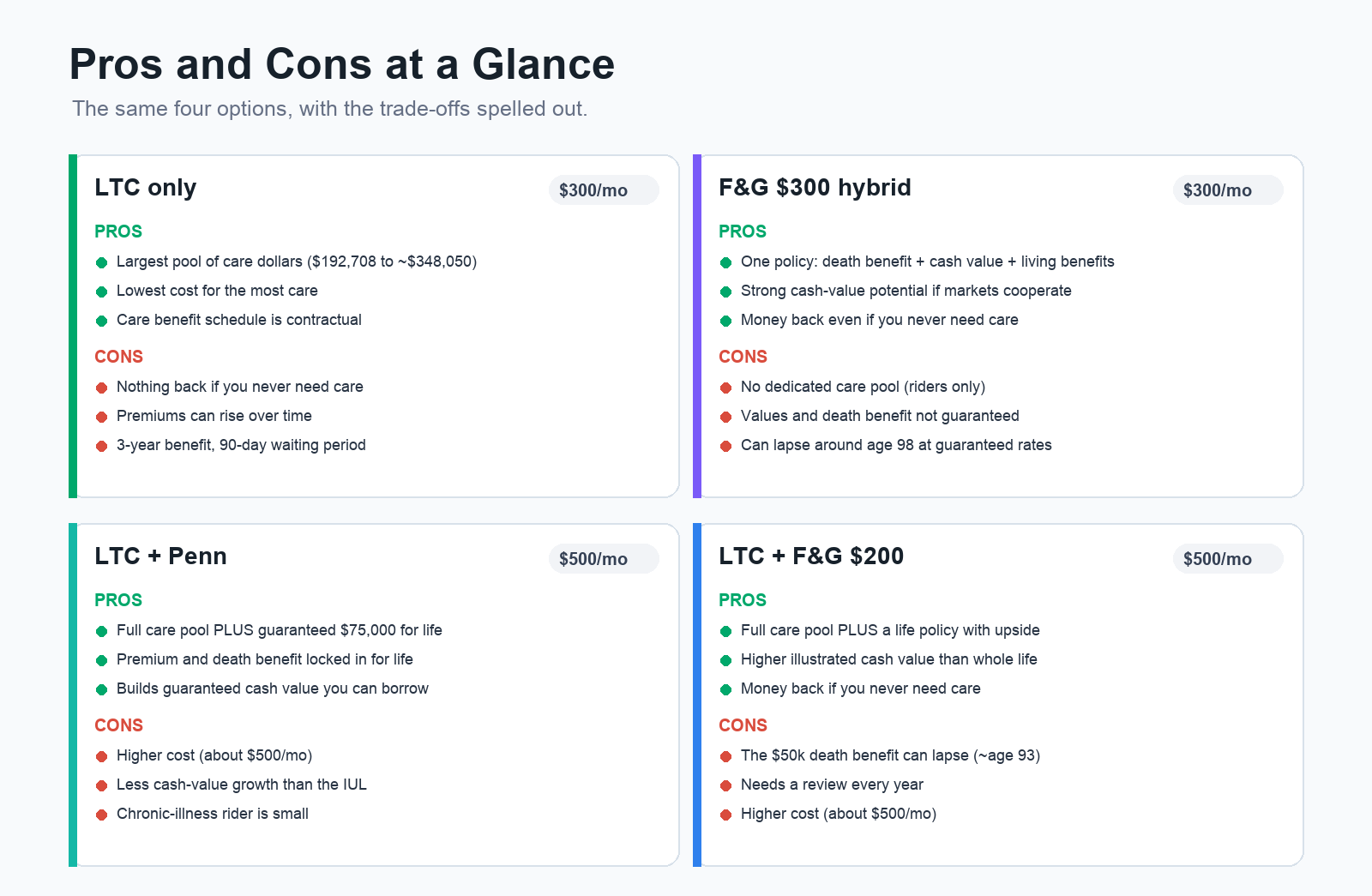
- LTC only — the most care money for the lowest price. The trade-off: if you never need care, nothing comes back.
- F&G $300 hybrid — one $300 policy that does a little of everything (death benefit, cash value, living-benefit riders). Good if you can’t decide, but it’s not a dedicated care pool and nothing is guaranteed.
- LTC + Penn — the full care pool plus a guaranteed $75,000 that goes to your family no matter what. The certainty pick.
- LTC + F&G $200 — the full care pool plus a life policy with more upside — but its death benefit isn’t guaranteed and needs watching.
If you need care, how much is there?
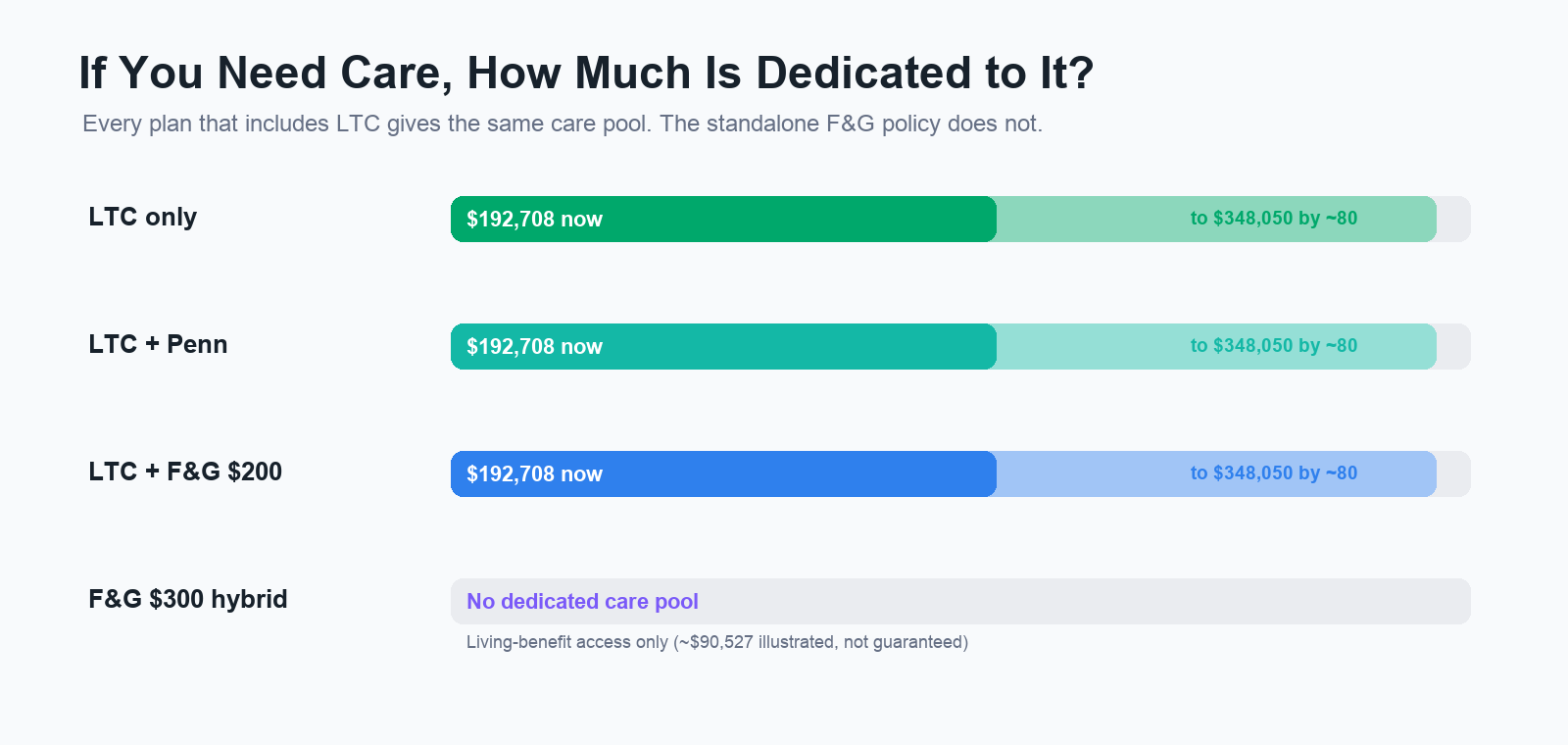
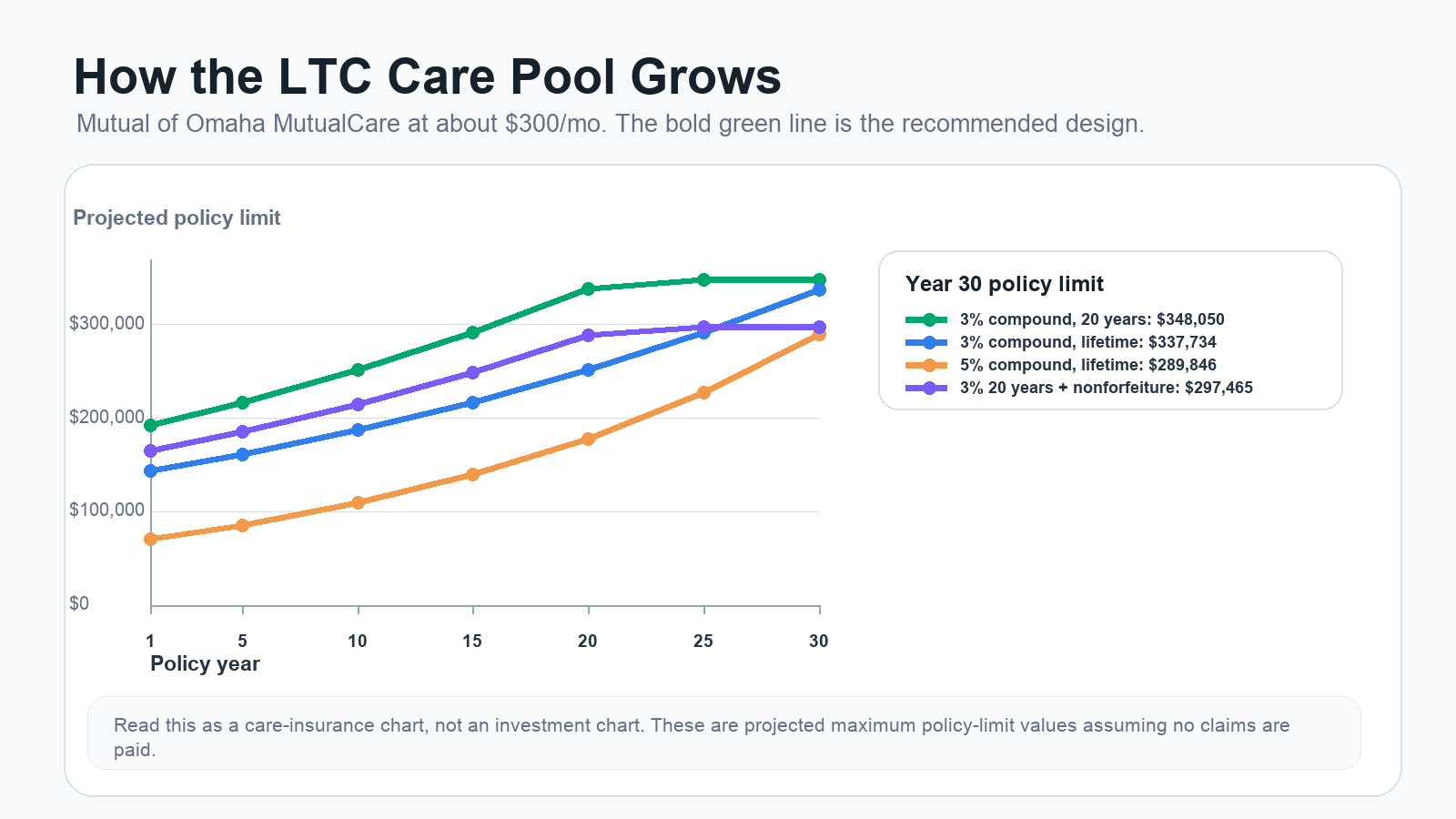
Three of the four options are built on the same Mutual of Omaha long-term care plan: a $192,708 pool at age 55 that grows with 3% compound inflation to about $348,050 by your 80s, paying up to $5,353/mo today (rising to about $9,666). It also includes a flexible cash benefit of about $1,338/mo for informal or family caregivers. The standalone F&G $300 hybrid is the exception — it has no dedicated care pool, only living-benefit riders that accelerate its death benefit.

View full-size chart
Scroll across and down to read the chart. Close this view when you finish.

View full-size chart
Scroll across and down to read the chart. Close this view when you finish.
If you never need care, what comes back?
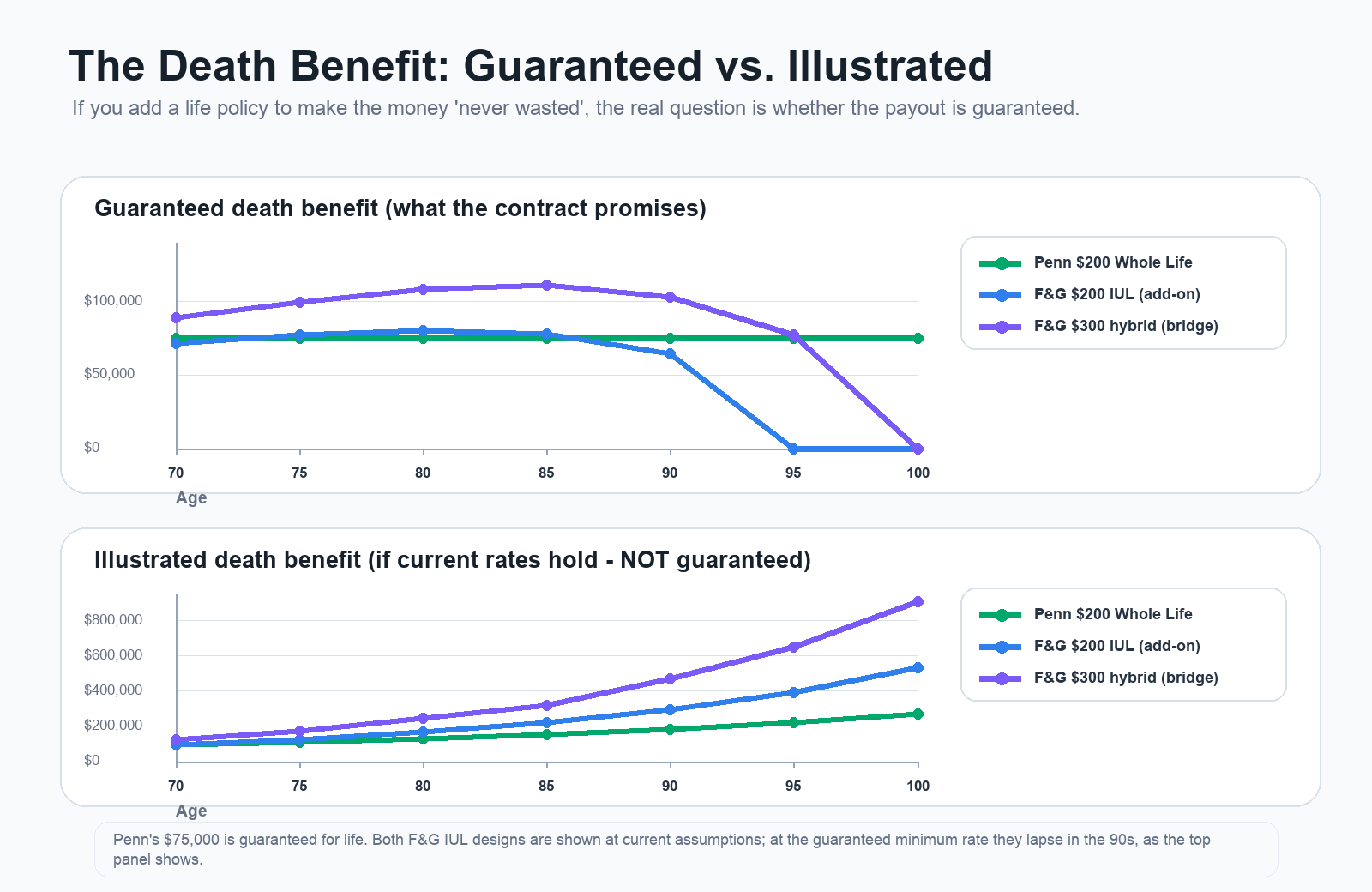
This is where the options separate. LTC only returns nothing. LTC + Penn pays your family a guaranteed $75,000 whenever you pass — for life. The two F&G designs also leave a death benefit, and if the market cooperates they can grow much larger than the whole life — but those values aren’t guaranteed. At the minimum guaranteed rate the F&G $200 add-on lapses around age 93 and the F&G $300 hybrid around age 98, taking the death benefit to $0. The chart shows both realities side by side.

View full-size chart
Scroll across and down to read the chart. Close this view when you finish.
The numbers behind the life options
Read honestly, guaranteed next to illustrated. The $200 columns are the add-on to LTC; the F&G $300 is the standalone hybrid.
| Feature | Penn Whole Life ($200) | F&G IUL ($200) | F&G IUL ($300) |
|---|---|---|---|
| Initial death benefit | $75,000 | $50,000 | $51,436 |
| Death benefit guaranteed for life? | Yes — $75,000 | No — can lapse ~age 93 | No — can lapse ~age 98 |
| Cash value at 80 (guaranteed) | $41,651 | $30,003 | $56,641 |
| Cash value at 80 (if current rates hold) | $82,755 | $116,471 | $192,165 |
| Chronic-illness access (example) | $25,518 at age 75 | $67,004 at age 70 | $90,527 at age 70 |
| Monthly premium | $200 | $200 | $300 |
| Main tradeoff | Lower illustrated growth, rock-solid guarantees | More upside, no guarantee it lasts | Most upside, still not guaranteed |
How to choose
LTC only
$300/moIf you need care: Largest care pool — $192,708 to ~$348,050.
If you never need care: Nothing comes back.
Watch: Best if you’re at peace with use-it-or-lose-it.
F&G $300 hybrid
$300/moIf you need care: No dedicated pool; living-benefit access (~$90,527 illustrated).
If you never need care: A death benefit + cash value, not guaranteed.
Watch: Best if you can’t decide or want one flexible policy.
LTC + Penn
$500/moIf you need care: Full $192,708 pool + a small chronic-illness benefit.
If you never need care: Guaranteed $75,000 to your family for life.
Watch: The certainty pick — the cleanest ‘money’s never wasted.’
LTC + F&G $200
$500/moIf you need care: Full $192,708 pool + chronic-illness access.
If you never need care: A death benefit with upside, not guaranteed.
Watch: Only if you want upside and will review it yearly.
Want the most care for the money, and you’re fine with use-it-or-lose-it? LTC only.
Want care plus money back you can count on? LTC + Penn — a guaranteed $75,000, if your budget can reach about $500.
Can’t decide, or want to start at $300 with one flexible policy? The F&G $300 hybrid — just know it isn’t dedicated care and isn’t guaranteed.
Want care plus market upside and you’ll watch the policy? LTC + F&G $200.
Bottom line
Long-term care insurance is the strongest foundation when care protection is the goal — it buys far more care than any life policy’s living-benefit rider. From there it comes down to what you want if you never need care: nothing back at the lowest cost (LTC only), a guaranteed $75,000 for your family (LTC + Penn), market upside you’re willing to monitor (LTC + F&G $200), or a single do-a-bit-of-everything policy while you decide (F&G $300 hybrid). When the goal is certainty, the guaranteed option wins; when it’s flexibility or growth, the F&G designs have more upside but no guarantee.
Important notes
- Long-term care insurance premiums may be subject to future rate increases, subject to policy terms and regulatory approval.
- IUL current values are not guaranteed. Caps, participation rates, spreads, cost-of-insurance charges, rider charges, and credited interest can change, and at guaranteed minimum rates the IUL designs shown here can lapse around age 93–98.
- Whole-life dividends are not guaranteed. Guaranteed values and current dividend-scale values are shown separately above.
- Accelerated death benefit riders are not the same as long-term care insurance. They may reduce the policy’s cash value, face amount, and death benefit.
- This summary is educational and based on the actual illustrations prepared for you (dated June 2026; issue ages 55–56). Your actual coverage depends on health, underwriting, budget, assets, family support, tax situation, and the final policy contracts.